The Micro-Hub + Cargo E-Bike Model: Rethinking Urban Last-Mile Logistics in 2026
 Share on X
 LinkedIn
 Facebook
 Reddit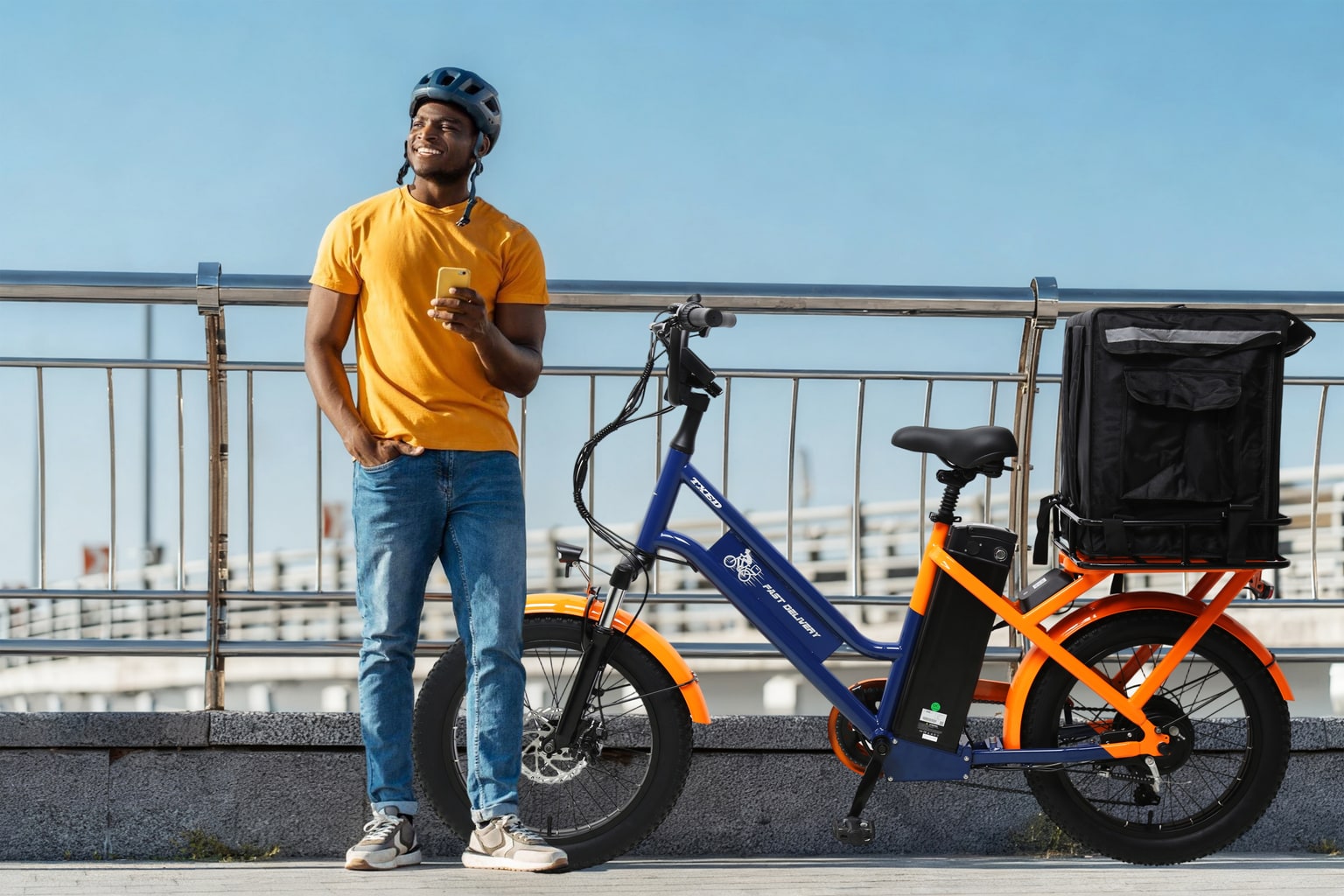
Here is the inefficiency hiding in plain sight in most city delivery networks: a 3.5-ton van carrying 300 kg of parcels, idling in traffic, circling for parking, and walking its driver the last 50 meters to every door. The vehicle spends most of its working day doing the two things it is worst at—creeping through dense streets and standing still.
The micro-hub model attacks exactly this waste. The idea is simple: let vans and trucks do what they do well—moving volume over distance—and let cargo e-bikes do what they do well: the dense, stop-heavy final kilometer. Between them sits a small transfer point, the micro-hub, where goods change vehicles once, close to the customer.
What was a pilot curiosity five years ago is now a serious operating model. Zero-emission zones keep expanding across Europe, congestion charges keep rising, and parcel volumes keep growing while city streets stay the same size. This guide explains how the model actually works: where micro-hubs go, what the transfer workflow looks like, how the economics compare to van-direct delivery, and how to run a pilot that produces a real decision.
What a Micro-Hub Actually Is (and Isn't)
A micro-hub is a small logistics transfer point—typically 50 to 500 square meters—located inside or at the edge of a dense delivery zone. Inbound freight arrives once or twice a day by truck or van, usually in roll cages or standardized containers. Inside the hub, parcels are sorted by route, and outbound delivery happens on cargo e-bikes (or on foot for ultra-dense blocks).
Micro-hubs take many physical forms, and most of them are cheaper than people expect:
- Repurposed retail or ground-floor space: vacant shops, unused office lobbies, underused parking garage levels—often the most practical option in city centers.
- Container or modular units: one or two shipping containers on a leased lot, deployable in weeks and relocatable if the route geometry changes.
- Shared or neutral hubs: multi-operator facilities, sometimes city-supported, where several carriers share space, sorting infrastructure, and even e-bike fleets.
- Mobile hubs: a truck or trailer that parks for a fixed window and acts as a floating depot—no lease, no fit-out, ideal for pilots.
What a micro-hub is not: a warehouse. There is no storage strategy, no racking, no inventory turns. Goods flow through in hours. If your design brief starts to include overnight storage and picking operations, you are building a fulfillment center—a different business with different economics.
Where the Model Works: The Density Equation
Micro-hub economics live and die on one variable: stop density within the hub's catchment. The cargo e-bike's advantage is not speed over distance—it is the near-zero cost of stopping. No parking search, no walking from a van two blocks away, no idling tickets. Every additional stop per kilometer amplifies that advantage.
| Catchment profile | Fit for micro-hub model | Why |
|---|---|---|
| Dense historic core / pedestrian zones | Excellent | Vans are slow, restricted, or banned; bikes access everything |
| Mixed urban residential + retail | Strong | High stop density; e-bike routes stay under 5 km average hop |
| Suburban sprawl, low density | Weak | Long distances between stops favor vans; bike range wasted on transit |
| Bulky goods (furniture, appliances) | Not suitable | Payload and volume exceed cargo bike envelopes—keep vans on these |
As a planning heuristic: if a single van route in the zone makes 40+ stops and average distance between stops is under 300 meters, a micro-hub with two or three cargo e-bikes will very likely beat it on cost per stop. If stops are 2 km apart, keep the van.
The Transfer Workflow, Step by Step
The operational choreography matters more than the real estate. A well-run micro-hub day looks like this:
- Inbound (typically early morning): one truck or van delivers pre-sorted roll cages or containers for the whole zone—one vehicle, one stop, no circulation in the core.
- Sort and stage (30–60 minutes): staff (often the riders themselves in small operations) sort parcels into route order and load bike boxes or cargo bays. Route planning software cuts this dramatically as volume grows.
- Outbound waves: riders run short loops—typically 45–90 minutes—returning to the hub to reload. A single hub can push 3–5 waves per rider per day, which is how a 3 km-radius catchment absorbs hundreds of parcels daily.
- Returns and exceptions flow backward: failed deliveries, pickups, and packaging returns consolidate at the hub and leave on the next inbound run. This reverse leg is an underrated advantage—van-direct networks often handle returns with a second van route.
- Midday top-up (optional): a second inbound drop supports afternoon waves for food, grocery, or same-day e-commerce peaks.
Notice what the hub removes from the system: vans no longer enter the dense zone at all. Their day becomes trunk runs between the distribution center and two or three hubs—predictable, fast, and fully utilized. Meanwhile the bikes never leave their sweet spot.
The Cost Structure: Where Money Moves
The micro-hub model does not eliminate cost—it moves it. You add a transfer step (space, sorting labor, hub overhead) in exchange for slashing the most expensive part of the old system: vans and drivers crawling through congestion. The trade usually looks like this:
| Line item | Van-direct | Micro-hub + cargo e-bike |
|---|---|---|
| Vehicle CapEx | High (vans, often leased) | Low per unit (e-bikes); plus hub fit-out |
| Labor per stop | High — driver wages + parking/search time | Lower — dense stops, no parking penalty; adds sorting labor |
| Energy / fuel | Diesel or large EV charging | Negligible (e-bike charging) |
| Access costs | Congestion charges, ZEZ fees, fines | Essentially zero inside restricted zones |
| Hub overhead | None | Rent, utilities, sorting staff, insurance |
| Failure buffer | Spare vans are expensive to hold | Spare bikes are cheap; riders redeploy flexibly |
The break-even math hinges on hub utilization. A hub processing 400 parcels a day spreads its rent and sorting labor thinly; a hub processing 80 parcels a day is an expensive room. This is why the model scales so well for parcel and grocery operators and so poorly for low-volume niche delivery—and why shared, multi-carrier hubs are attracting city support: pooling volume fixes utilization for everyone.
The van's day, re-examined
Time-motion studies of urban van routes consistently find drivers spend a large share of the shift not driving—searching for parking, walking to doorways, waiting at loading bays. Every one of those minutes is paid at van-driver cost. The micro-hub model converts those minutes into either more stops (bike density) or eliminated cost (trunk efficiency). That, more than energy savings, is where the business case usually closes.
Site Selection: Five Filters for a Hub Location
- Catchment density first: map your stops, not your intuition. The hub should sit so that most deliveries fall within a 2–4 km e-bike loop.
- Truck access without city access: inbound freight must reach the hub easily from the ring road or arterial—without the truck needing to penetrate the core. Edge-of-zone beats center-of-zone.
- Bike infrastructure out the door: the hub's advantage evaporates if riders must fight hostile traffic for the first kilometer. Protected lanes or calm streets radiating from the site matter.
- Ground-floor, drive-up practicality: roll cages hate stairs, lifts, and long corridors. A loading edge, a shutter, and 100 square meters beats a beautiful space with bad access.
- Lease flexibility: route geometry shifts with seasons and contracts. Favor 12–24 month terms, modular spaces, or mobile-hub pilots over long commitments until volumes stabilize.
A Realistic Pilot Path: 90 Days to a Decision
The fastest way to kill a micro-hub project is to build the full network first. The fastest way to prove it is a tightly-scoped pilot:
- Weeks 1–2 — Baseline: instrument one existing van route in a dense zone. Measure cost per stop, stops per hour, parking time, and failed-delivery rate. You cannot prove improvement without a before picture.
- Weeks 3–4 — Minimal hub: stand up the cheapest possible transfer point: a rented container, a corner of an existing depot, or a parked trailer. Two or three cargo e-bikes, one rider each, one inbound drop per morning.
- Weeks 5–10 — Operate and iterate: run the same deliveries the van used to do. Expect the first two weeks to be slower—that is learning, not signal. Tune loop design, box loading order, and wave timing.
- Weeks 11–13 — Compare and decide: put pilot numbers next to baseline: cost per stop, on-time rate, stops per rider-hour, vehicle downtime. Decide on scale-up, redesign, or stop.
Keep the pilot honest with pre-agreed decision gates: for example, "scale if cost per stop is within 10% of van-direct by week 10 with equal or better on-time rate"—knowing that scale and software usually close the remaining gap. For a full framework on structuring this kind of trial, see our guide on matching delivery e-bikes to fleet scenarios.
Common Failure Modes to Avoid
- Choosing the hub by rent, not by density: a cheap room in the wrong place costs more than an expensive room in the right one, forever.
- Under-speccing the bikes: hub operations mean full loads, all day, every day. Consumer-grade e-bikes fail in months; specify commercial frames, brakes, and—critically—an energy system sized for loaded routes, often dual batteries or swap.
- Forgetting the sort: "we'll figure out sorting later" turns the hub into a daily bottleneck. Even a tape-on-floor grid and labeled shelves beat improvisation.
- Ignoring reverse logistics: returns and pickups are 10–20% of urban parcel volume. Design the backward flow on day one, or it will design itself badly.
- Skipping the city conversation: many municipalities actively support micro-hubs—permits, space programs, ZEZ exemptions for clean fleets. Operators who ask early often find doors open that their competitors don't know exist.
Where This Leaves Vans
Not obsolete—reassigned. In the networks we see working in 2026, vans handle the trunk (distribution center to hub, bulky goods, low-density suburbs) and cargo e-bikes own the doorstep in dense zones. The fleet that wins is not the one that picks a side; it is the one that puts each vehicle on the part of the route where it is cheapest per stop.
For the full three-platform comparison behind that split, read Cargo E-Bike vs Van vs E-Moped: Real TCO for Urban Delivery Fleets.
Plan Your Hub Fleet with TXED
TXED supplies the vehicle side of micro-hub networks: commercial cargo e-bikes built for all-day loaded duty, dual-battery and swappable-pack configurations for multi-wave operations, and OEM/ODM customization for operator branding and box integration.
If you are scoping a micro-hub pilot, send us:
- Target zone, stop density, and daily parcel volume per hub
- Planned waves per day and required vehicle availability
- Payload and box dimensions per stop
- City regulatory context (ZEZ, vehicle category limits)
Next step: explore the delivery & cargo e-bike range, or contact the B2B team to spec a pilot fleet. For market context, see Why Cargo E-Bikes Are the Next Big Trend in European Urban Mobility and 5 Real-World Cargo E-Bike Use Cases Transforming Urban Logistics.