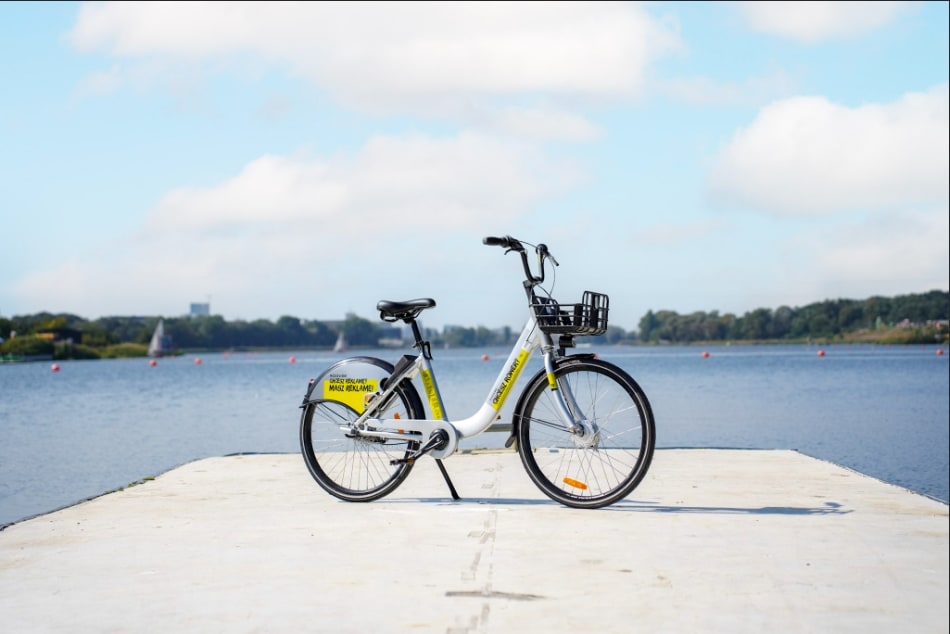
Inside TXED's New Sharing E-Bike: How 16.9 kg and Puncture-Proof Tires Change Fleet Economics
 Share on X
 LinkedIn
 Facebook
 Reddit
When operators evaluate a sharing e-bike, they don't care about spec sheets the way consumers do. They care about one thing: what does this bike cost me per ride, per month, per year?
Every design decision—frame material, tire type, cable routing, motor placement—either adds to or subtracts from that number. That's the lens we used when engineering our latest sharing e-bike, and it's the lens we'll use to walk you through it.
16.9 kg: Why Weight Is an Operating Cost
Most sharing e-bikes on the market weigh between 22 and 30 kg. Ours comes in at 16.9 kg. That's not a vanity metric—it has direct operational consequences.
- Rebalancing efficiency: When your operations team moves bikes between stations, lighter bikes mean more units per van trip. At 16.9 kg vs. 25 kg, you fit roughly 40% more bikes per load. Over thousands of rebalancing runs per year, that's a measurable reduction in logistics costs.
- Rider adoption: Lighter e-bikes feel more natural to ride, especially for casual users who aren't accustomed to the heft of electric bikes. This translates to higher ride completion rates and better user reviews—both of which affect permit renewals in competitive markets.
- Infrastructure flexibility: Lighter bikes put less stress on docking hardware and charging racks, extending the service life of your ground infrastructure.
Achieving 16.9 kg on a sharing-grade e-bike required trade-offs. We use a high-tensile aluminum alloy frame that maintains the rigidity needed for daily fleet abuse while cutting weight. The 36V/250W rear hub motor is compact but delivers enough torque for urban gradients up to 15%. The 36V/13Ah battery pack uses Samsung cells—heavier per watt-hour than some alternatives, but the cycle life (1,500+ cycles to 80% capacity) justifies the weight.
"We could have shaved another 1-2 kg by using cheaper cells, but you'd replace the battery twice as often. Weight savings that increase total cost of ownership aren't savings at all."
Puncture-Proof Foam Tires: Eliminating the #1 Maintenance Call
Ask any fleet operator what their most frequent maintenance issue is. The answer is almost always flat tires.
Pneumatic tires on shared bikes face a brutal environment: glass, nails, curbs, potholes, and riders who don't notice (or don't care about) low pressure. A single flat tire takes a bike offline for hours or days—depending on how quickly your field team can respond.
Our foam tire system eliminates this entirely:
- Zero flats: Closed-cell foam cannot puncture. Period. The bike stays in service regardless of road conditions.
- No pressure maintenance: Pneumatic tires lose pressure over time. Riders on under-inflated tires experience worse handling and accelerated tire wear. Foam tires maintain consistent performance without any maintenance.
- Reduced field labor: Every flat tire avoided is a service call saved. For a 500-bike fleet experiencing an industry-average flat rate of 2-3% per week, that's 10-15 fewer dispatches every week—easily 500+ avoided service calls per year.
The common objection to foam tires is ride comfort. Early solid tires were genuinely harsh—they transmitted every crack and seam directly to the rider. Our current-generation foam compound is engineered to approximate the damping characteristics of a pneumatic tire at 45 PSI. Riders consistently report that they can't tell the difference on typical urban surfaces.
For operators, the math is straightforward: foam tires cost slightly more per unit upfront, but the elimination of flat-related maintenance pays back that premium within the first 2-3 months of deployment.
99% Hidden Cables: Anti-Vandal by Design
Exposed cables on shared bikes are an invitation. They get cut, pulled, tangled, and weathered. Each incident means a repair ticket, parts, and a bike sitting in your warehouse instead of earning revenue.
We route 99% of cables internally—brake lines, motor wiring, sensor connections, and IoT module cables all run inside the frame and handlebars. The result:
- Vandal resistance: There's simply nothing accessible to cut or pull. The few external connection points use tamper-resistant fasteners.
- Weather protection: Internal routing shields cables from UV degradation, rain ingress, and temperature cycling. Key components are rated IPX5+, with critical electronics at IPX7.
- Cleaner aesthetics: This matters more than operators might think. Municipal partners and riders both respond positively to bikes that look maintained and intentional rather than cobbled together.
Internal cable routing adds complexity to manufacturing—it requires precise frame engineering and careful assembly processes. But it dramatically reduces field maintenance related to wiring issues, which typically accounts for 15-20% of non-tire repair tickets in conventional sharing fleets.
Smart Lock and IoT: The Invisible Layer
The physical bike is only half the product. The IoT and locking system determines how the bike integrates with your sharing platform, your operations dashboard, and your city's regulatory requirements.
Our system supports multiple deployment configurations:
- Dockless with geofencing: Intelligent frame lock with GPS enables free-floating deployment with virtual parking zones.
- Docked systems: Electronic cable lock pairs with our charging racks for orderly parking and simultaneous charging.
- Hybrid models: Electronic tag matching with TXED's parking system enables flexible zone-based deployment without fixed docks.
The integrated color LCD panel shows battery status and ride information, reducing "is this bike charged?" uncertainty that leads to abandoned ride attempts. Real-time telemetry feeds battery health, location, and usage data to your fleet management system—enabling the predictive maintenance and AI rebalancing that modern operators increasingly rely on.
All IoT components are integrated during manufacturing rather than retrofitted, which means better waterproofing, more reliable connections, and the ability to push over-the-air firmware updates across your entire fleet.
The Charging Infrastructure Piece
A sharing e-bike is only as useful as its charging system. We offer two approaches:
- Wired charging racks: Stable, cost-effective, and proven. Bikes dock into purpose-built racks that simultaneously charge and organize the fleet. This is our recommended approach for operators who want maximum reliability at the lowest infrastructure cost.
- Wireless charging: Cleaner deployment with no exposed connectors to corrode or break. Higher upfront cost, but eliminates the most common charging infrastructure failure point (damaged connectors).
Both systems support the 36V/13Ah battery pack, delivering a full charge in approximately 4-5 hours and providing an average range of 70 km per charge. For most urban sharing operations, that means each bike can complete a full day of rides on a single overnight charge.
Certification: TÜV and CE as Standard
Every unit ships with TÜV Rheinland certification and CE marking. This isn't optional—it's built into our production process with regular third-party audits.
For operators deploying in the EU, this means no customs surprises, no insurance gaps, and no compliance scrambles. For markets outside Europe, we support additional certifications (UL, AS/NZS) based on deployment requirements. We covered the importance of proper certification in detail in our previous article on TÜV and CE compliance.
What It Adds Up To
Individual features don't tell the full story. Here's what the combination delivers in operational terms:
| Metric | Industry Average | TXED Sharing E-Bike |
|---|---|---|
| Bike weight | 22-30 kg | 16.9 kg |
| Flat tire incidents | 2-3% of fleet/week | 0% |
| Cable-related repairs | 15-20% of tickets | Near zero |
| Fleet availability | 75-85% | 95%+ |
| Range per charge | 40-50 km | 70 km |
| Water resistance | IPX4 | IPX5+ (critical: IPX7) |
These aren't abstract improvements—they translate directly to fewer service calls, higher fleet uptime, and lower cost per ride. For a 500-bike deployment over three years, the difference between a conventional sharing bike and this platform typically amounts to 35-45% lower total cost of ownership.
We built this bike because our operator partners kept telling us the same thing: they needed a platform that costs less to operate, not just less to buy. Every design choice—from the foam tires to the hidden cables to the Samsung cells—was made with that principle in mind.
Want to see detailed specs or discuss a deployment? Get in touch—we'll send you a full technical package and connect you with operators already running this platform.