A Delivery E-Bike Built for the Whole Shift: The 20-inch Fat-Tire Build Walkthrough
 Share on X
 LinkedIn
 Facebook
 Reddit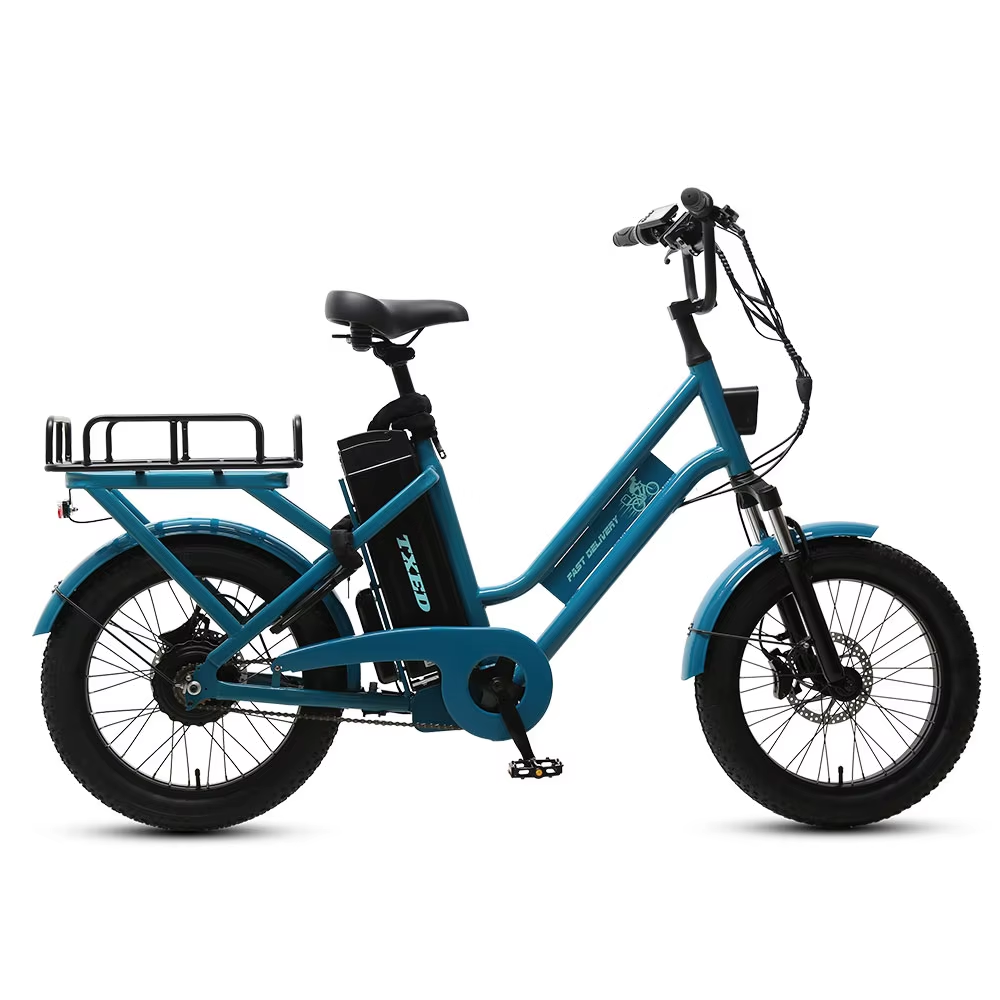
A delivery e-bike is judged by one number that never appears on a spec sheet — how many full shifts it runs before something pulls it off the road. The build below is our 20-inch fat-tire delivery platform: a TIG-welded steel frame, 48V/500W rear hub motor, 48V/25Ah battery, hydraulic disc brakes, single-speed drivetrain, GPS tracking, and a full accessory and security package. This article walks each line item and the engineering reason it is there, so a brand or fleet buyer can read the build the way our engineers do.
Most delivery e-bikes on the market are commuter frames with a rack bolted on. The result is predictable: frames flex under load, drivetrains eat themselves in stop-and-go torque, batteries run out before the shift ends, and a single missing anti-theft layer turns a parked bike into a write-off. The build on this page is the opposite exercise — every component is chosen for an eight-hour, loaded, urban duty cycle, not for a spec-sheet headline. The sections below follow the order a buyer would audit the bike on the loading dock.
1. Frame: 20-inch TIG-welded steel, built for a loaded duty cycle
The frame is 20-inch, TIG-welded steel construction. We chose steel over aluminum for a delivery platform for three reasons: it is fatigue-tolerant under the cyclic loading of a loaded rack, it welds and repairs cleanly in the field, and it damps vibration that would otherwise transmit to the battery mount and electronics. A 20-inch wheelbase keeps the wheel path short and the overall package dense, which matters when the bike lives in a lift, a corridor, or the back of a van between shifts.
TIG welding — rather than the faster, cheaper MIG process common on budget frames — gives a narrower heat-affected zone and a more consistent penetration profile at the head tube, seat tube junctions and dropouts. Those are the joints that carry the rider-plus-payload dynamic load and the rear hub motor's reaction torque. A clean TIG bead is not cosmetic on a delivery frame; it is the difference between a frame that lasts the fleet cycle and one that cracks at the dropout under sustained motor torque.
Why 20-inch: a smaller wheel drops the load's center of gravity, shortens the wheelbase for elevator and corridor work, and leaves more frame volume for a large-diameter seat tube and a battery well that actually fits a 25Ah pack without hanging it exposed.
2. Suspension fork: alloy crown, tuned for urban debris
An alloy-crown suspension fork sits up front. The alloy crown keeps the unsprung and overall weight down compared to a full-steel fork, which matters because a lighter front end reduces steering inertia and rider shoulder fatigue across a shift of constant kerb-cut transitions. The suspension stroke absorbs the high-frequency hits — expansion joints, cobble, construction plates — that would otherwise transmit straight into the handlebar and the front cargo or lighting mount.
The engineering reason this fork is on the build, and not a rigid fork, is the same reason a delivery bike is not a commuter: a rigid fork transfers every impact into the headset bearings, the lighting mount and the rider's wrists, and over an eight-hour shift that compounds into maintenance events and attrition. A modest suspension stroke is the cheapest insurance against front-end fastener loosening and light-bracket fatigue.
3. Hydraulic disc brakes: front and rear, with electric levers
The bike runs hydraulic disc brakes at both wheels, with electric cut-off levers. Hydraulic — rather than mechanical cable disc — is non-negotiable on a loaded delivery bike for three reasons: hydraulic gives a higher and more linear clamp force for less lever effort, the system self-adjusts for pad wear so the bite point does not drift across a shift, and the sealed fluid line does not corrode or stretch the way a Bowden cable does in wet, salted or dusty urban conditions.
The electric levers are the safety-critical detail. The moment either lever is touched, the lever switch opens the motor circuit and cuts assist — this is the EN 15194 mandatory stop behavior, and on a 48V/500W bike it is what keeps a loaded stop from becoming a loaded slide. We hardwire the cut-off rather than relying on a software path, so a display or controller glitch can never leave the motor pulling against the brakes.
4. Single-speed drivetrain: the low-maintenance fleet answer
The drivetrain is single-speed: a steel crank and chainring driving a KMC chain. On paper a derailleur offers more gear range, but on a delivery duty cycle the single-speed wins on the metric that actually costs a fleet money — mean time between service events. A derailleur on a delivery bike is a bent hanger waiting to happen: it gets knocked on racks, thrown by kerb strikes, and choked with grit within weeks. A single-speed has none of that exposure.
The motor and battery combination (below) is what makes single-speed viable on a loaded bike. The 500W rear hub motor supplies the low-end torque that a rider's knees would otherwise have to provide off the line, so the gear ratio can be picked for cruising efficiency rather than standing-start torque. The result is a drivetrain with one chain, one chainring, no shifter cable — the chain is the only wear item, and a KMC chain is specified so the replacement part is a standard SKU anywhere in the world.
5. 48V/500W brushless rear hub motor: PAS and throttle
The motor is a 48V/500W brushless rear hub unit, driving the rear wheel directly with no internal gears to wear or lubricate. 48V is the right system voltage for a delivery bike because it keeps the controller switching current low for a given power output — less current means thinner harness, cooler controllers, and a battery that lasts more charge cycles. The 500W rating is the sweet spot for a 20-inch loaded wheel: enough torque to pull away loaded from a standing start without pedaling, without the weight and heat penalty of a 750W unit.
Both PAS (pedal assist) and a throttle are fitted. The two modes answer different moments in a shift: PAS is the long-haul mode, where the motor scales to the rider's effort and the battery lasts the full route; the throttle is the start-line and hill mode, where the rider needs instant torque without standing on the pedals. Letting the rider choose, per moment, is what keeps a full shift physically sustainable and the battery inside its range budget.
6. 48V/25Ah battery: the shift-long energy budget
The battery is a 48V/25Ah lithium pack — a 1.2 kWh class energy budget, shipped with a 48V/3A charger. On a delivery duty cycle, range is not a comfort spec; it is the constraint that decides whether a single bike covers one route or two. A 25Ah pack at 48V gives enough headroom that, even with throttle-heavy use, a loaded bike on a hilly city loop can complete a full shift without a mid-route swap, and the 3A charger recovers a meaningful share of that capacity over a normal meal break.
The engineering point that matters to a fleet buyer is not the headline capacity — it is the usable capacity after BMS reserve and aging. The pack is sized so that at end-of-warranty, after nominal capacity fade, it still carries a full-shift budget. That is the difference between a battery that lasts a season and one that ages out of the route in a year. The BMS, cell spec and pack construction can be validated against your fleet's duty cycle and target market regulations before the order is locked.
7. 20-inch × 3.0 fat tires: traction and stability on every surface
The bike runs 20 × 3.0 fat tires on alloy single-wall rims with brass nipples. A 3.0-inch casing at moderate pressure puts a wide, compliant contact patch on the ground — the tire absorbs kerb strikes and debris that a narrow tire transmits as punctures, and the contact area lowers ground pressure enough to keep traction on sand, snow, wet cobble and painted lines. For a delivery bike that stops and starts every few hundred meters, that low-speed traction is also a safety spec, not just a comfort one.
The wheel build is chosen for the same duty cycle. Alloy single-wall rims keep the rotating mass reasonable on a 20-inch platform, and brass nipples are specified over alloy for a reason that only matters at the depot: brass does not corrode under wet-and-salt exposure, so a spoke retension is a workshop event, not a nipple-replacement event. The fat casing and the brass-nipple wheel build are the details that keep a delivery bike on the road between scheduled services rather than at the depot for unscheduled ones.
8. Rider comfort: suspension seat post and reflectorized pedals
A suspension seat post with a quick-release clamp absorbs the vibration that gets past the fork and the fat tires — the lower-frequency road buzz that, over an eight-hour shift, turns into lower-back attrition and rider turnover. The quick-release clamp is not a convenience feature on a delivery bike; it is a sizing feature, so a single bike in a pool fleet can be adjusted to a different rider between shifts without a tool.
The alloy pedals carry reflectors, and that detail is doing two jobs at once. The pedal body is alloy rather than plastic because a delivery pedal gets struck on kerbs and racks every shift, and a plastic body will chip or crack where an alloy body survives. The reflectors make the bike legal for night-shift use in most jurisdictions and, more importantly, make the rider's foot motion visible to following traffic — the single most effective passive visibility aid on a stopped or low-speed bike.
9. Full accessory package: fitted at the factory, not bolted on after
The build ships with a complete accessory package: bell, steel P-type chain cover, alloy double-leg kickstand, front and rear steel mudguards, and main battery-powered lights. The engineering point here is not the list — it is that the accessories are fitted on the line, against the frame they were designed for. A mudguard that is engineered to the frame does not rattle loose in week three; a light that is wired into the build does not get stolen or run out of battery on a rack-piggybacked unit.
The double-leg kickstand is worth calling out specifically. A single-leg kickstand is fine on a commuter; on a loaded delivery bike it is the reason bikes get tipped over in loading bays, taking the cargo and the rider with them. A double-leg stand holds the bike vertically stable under a loaded rack, which is the only configuration that lets a rider stage a delivery on the rack without getting off and steadying the bike. It is a small line item that quietly removes a class of depot incidents.
10. GPS tracking and the horseshoe chain lock
Integrated GPS gives anti-theft and real-time location monitoring, and the bike also ships with a horseshoe chain lock fitted with a 4G SIM. The two layers answer two different theft moments. The chain lock answers the opportunistic theft — a bike left on a curb between drops, where the lock has to hold long enough for the rider to return. A horseshoe chain resists bolt-croppers and leverage attacks better than a cable or a basic D-lock in the same weight class.
The GPS answers the professional theft — the moment the chain lock is defeated or the bike is loaded into a van. Integrated GPS (rather than a tracker bolted on after) means the unit is powered from the main battery, hidden inside the frame, and not removable without taking the bike apart. The 4G SIM in the lock is the redundant layer: if the main battery is dropped or the GPS unit is jammed, the lock's own 4G link still reports position. For an urban fleet, this is the difference between a stolen bike being gone and a stolen bike being recoverable in hours.
11. PAS/throttle with LCD display: the rider's instrument panel
A speed-sensor PAS drives the assist, and an LCD display gives the rider clear ride data — speed, assist level, battery state, trip distance. The speed sensor (rather than a cadence sensor) measures actual wheel speed, so the assist ramps with real ground speed rather than crank rotation. The practical difference is that the bike does not lurch when the rider backpedals to reposition at a stop, and the assist cuts cleanly at the speed limit — both of which are comfort and compliance items on a stop-and-go delivery loop.
The display is the rider's instrument panel and, on a fleet bike, the depot's too. A readable LCD means the rider can see state-of-charge at a glance and decide whether a route needs a swap, rather than discovering the budget is gone halfway out. For the depot, the same display surface is where fleet telematics and odometer readings can be surfaced if the build is specified with connectivity — turning the rider-facing unit into the maintenance-scheduling input as well.
12. SKD 85% packaging: less assembly, less transit damage
The bike ships SKD (semi-knocked-down) at 85% pre-assembly, in a seaworthy carton. The 85% level is the deliberate trade-off: the bike is assembled far enough that the headset, fork, motor, brakes, drivetrain and electronics are factory-built, aligned and torqued on the line — not by a downstream assembler with a different tool standard. The remaining 15% is the front wheel, seat post, pedals and a small set of accessories, which a brand or depot can complete in minutes without re-truing or re-bleeding anything.
The seaworthy carton is the other half of the spec. A delivery bike is dense and heavy, and the carton has to survive intermodal transit — container handling, stack pressure, humidity — without transmitting load into the fork or the rack. SKD 85% in a seaworthy carton is what lets a brand receive bikes that need a final assembly pass, not a rework pass, which is the difference between a clean launch and a depot full of "fit and finish" tickets on day one.
13. The build at a glance
The table below maps each line item to the duty-cycle demand it answers, so the spec sheet reads as a set of engineering decisions rather than a parts list:
| Component | Specified for |
|---|---|
| 20-inch TIG-welded steel frame | Loaded fatigue, motor torque, compact stowage |
| Alloy-crown suspension fork | Urban debris, headset and fastener longevity |
| Hydraulic disc brakes + electric levers | Loaded stopping power, mandatory motor cut-off |
| Single-speed steel drivetrain, KMC chain | Low maintenance, global replacement SKU |
| 48V/500W brushless rear hub motor | Loaded standing-start torque, cool running |
| 48V/25Ah battery + 48V/3A charger | Full-shift range, end-of-warranty headroom |
| 20 × 3.0 fat tires, brass-nipple rims | All-surface traction, corrosion-free service |
| Suspension seat post + alloy/reflector pedals | Shift-long rider comfort and night visibility |
| Full accessory + double-leg kickstand | Fitted on the line, stable loaded staging |
| Integrated GPS + 4G horseshoe chain lock | Opportunistic and professional theft layers |
| Speed-sensor PAS + LCD display | Smooth assist, fleet-facing ride data |
| SKD 85%, seaworthy carton | Clean final assembly, transit damage resistance |
14. The takeaway
A delivery e-bike is not a commuter with a rack. Every line on the build above exists because the bike has to run a loaded, eight-hour, urban duty cycle and come back ready for the next one. The frame is steel because it survives the load; the drivetrain is single-speed because it removes a whole failure class; the battery is 25Ah because a full shift has to fit inside the usable budget; the GPS and the 4G lock are there because a delivery bike that cannot be recovered is not an asset. The question to put to your OEM is the same one our engineers answered on this build: "Does every line item on the spec sheet earn its place against the duty cycle?" If it does, the fleet runs clean.
TXED builds the 20-inch fat-tire delivery e-bike platform shown here with TIG-welded steel frame, 48V/500W rear hub motor, 48V/25Ah battery, hydraulic disc brakes, integrated GPS and the full SKD 85% accessory package. Motor rating, battery capacity, connectivity and target-market compliance can be configured to your fleet's duty cycle and destination. This article is general product engineering guidance, not legal advice — confirm the motor power, e-bike classification and lighting requirements for your destination market with your test lab or authorized representative. Talk to us about your delivery fleet spec.